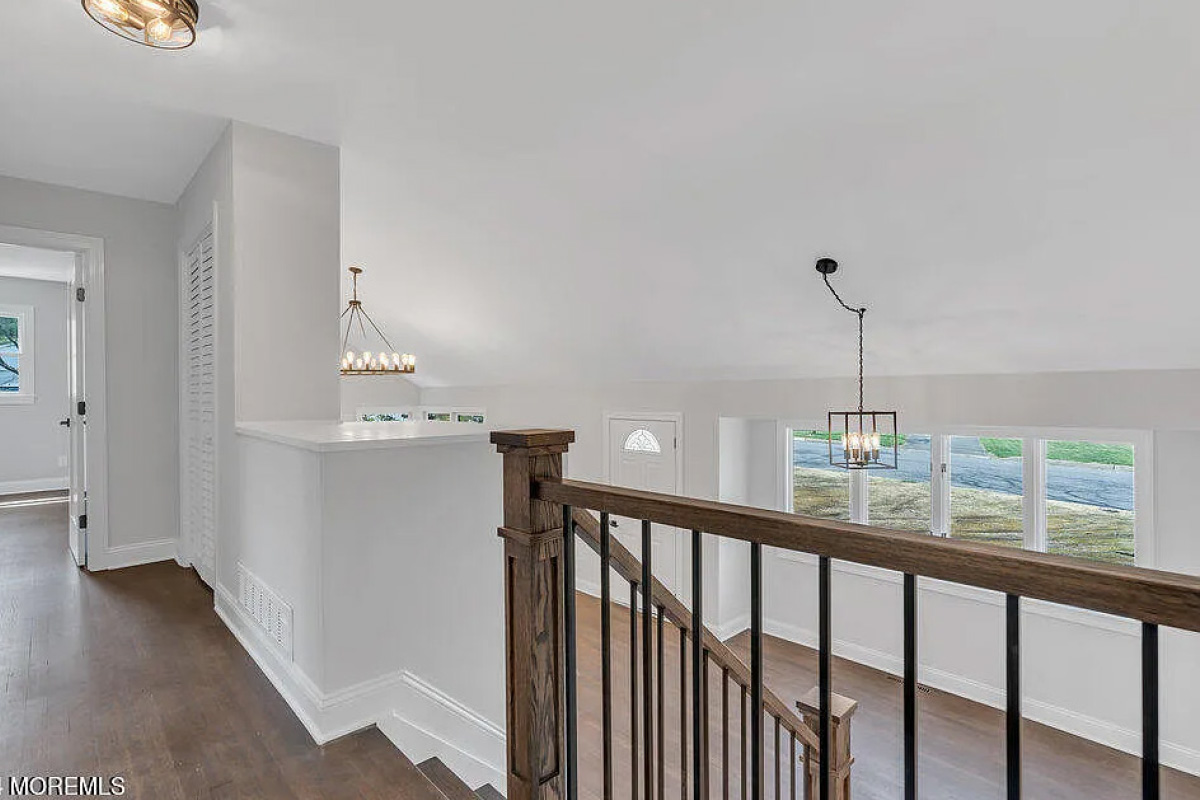
The staircase is one of the most visible and highest-traffic areas of any New Jersey home. What covers those treads matters both for how the home feels day to day and for what a future buyer sees when they walk through the front door. The hardwood-vs.-carpet question for stairs comes up constantly in Monmouth County and Ocean County homes, and there is rarely a one-size-fits-all answer.
This guide lays out the honest comparison between hardwood stair treads and carpet upfront cost, long-term value, safety, maintenance, and what the market rewards at resale. We have done enough stair projects across New Jersey to have a clear-eyed view of where each option shines and where it falls short.
The Case for Hardwood Stair Treads
The appeal of hardwood stair treads goes beyond aesthetics, though aesthetics are a significant part of it. A staircase finished in white oak or red oak treads with painted white risers makes a formal visual statement that carpet simply cannot match. In transitional and contemporary Monmouth County homes particularly in towns like Rumson and Red Bank where design expectations run high hardwood stairs have become close to standard.
The more compelling argument, though, is longevity. A quality hardwood tread installed and finished properly will last for decades. When the finish eventually wears typically after 10 to 15 years of heavy use the tread can be sanded and refinished in place, restoring its original appearance without replacement. This refinishing cycle can repeat multiple times before the wood becomes too thin to sand safely.
Hardwood treads are also far easier to keep clean than carpet. Pet hair, dust, and tracked-in soil sit on the surface and can be swept or vacuumed in seconds. Stains from spilled drinks or tracked-in mud wipe off the finish rather than absorbing into the fiber. For households with dogs or young children, this cleaning advantage is substantial.
Hardwood Stair Tread Advantages at a Glance
- 30–50-year lifespan with proper maintenance and periodic refinishing
- Can be sanded and refinished when finish wears no replacement needed
- Easy to clean; does not trap allergens, pet hair, or odors
- Strong resale appeal in NJ's current market
- Visually unifies staircase with adjacent hardwood floors
- No carpet padding replacement, tacking strips, or gripper rod maintenance
The Case for Carpet on Stairs
Carpet on stairs is not simply the "budget choice." It has genuine practical advantages that are worth acknowledging before dismissing it outright.
Traction is the most defensible argument for carpet. A well-padded carpet runner or full-carpet treatment provides reliable grip underfoot regardless of socks, bare feet, or wet shoes important in homes with elderly family members or very young children just learning to navigate stairs. For households where slip risk is a genuine daily concern, carpet provides inherent safety that hardwood requires additional measures to match.
Noise is the second real advantage. Hardwood stair treads transmit sound efficiently. Every footfall, especially in socks or hard-soled shoes, is audible throughout the home. Carpet absorbs impact noise significantly. In multi-story Ocean County homes where bedrooms sit directly above staircases, the noise difference between carpet and hardwood stairs is not trivial it can genuinely affect quality of life.
And the upfront cost of carpet on stairs is lower. A carpeted flight of 13 to 15 stairs can be done for $600 to $1,500 installed, compared to $1,500 to $3,500 for hardwood treads. For a homeowner focused on immediate budget rather than long-term value, the math favors carpet in the short term.
Converting carpet stairs to hardwood in NJ?
We handle stair tread installation throughout Monmouth County, Ocean County, and Middlesex County including color matching to your existing floors.
Cost Comparison: Installation and Long-Term Value
The upfront vs. lifetime cost comparison is where hardwood treads make their strongest case as the better investment.
Carpet on stairs in a New Jersey home requires replacement roughly every 7 to 10 years in an active household sooner with pets. Each replacement involves removing the old carpet and padding, installing new materials, and disposing of the old. Over 30 years, a Middlesex County homeowner might replace their stair carpet two to three times, spending $1,500 to $4,500 in total across those replacement cycles.
Hardwood treads, by contrast, are installed once and refinished as needed. A full refinish of a standard 15-tread staircase runs roughly $400 to $800. Even accounting for two refinish cycles over 30 years, the total maintenance spend is far below the cumulative carpet replacement cost and the stair treads themselves are still in place, still sound, and still adding value to the home.
"Over a 30-year horizon, carpet stairs and hardwood treads aren't even close. The carpet gets replaced two or three times; the hardwood gets refinished once or twice and looks better at the end than the day it was installed."
Resale is the other financial dimension. In today's New Jersey real estate market particularly in Monmouth County buyers have strong preferences for hardwood. Carpet on stairs is routinely listed on pre-purchase inspection reports as a near-term replacement item, and savvy buyers discount their offers accordingly. Hardwood stair treads that match the rest of the home's floors present as a premium, move-in-ready feature.
Safety, Noise, and Practical Considerations
The slip argument against hardwood stairs is legitimate but often overstated. The risk is real on polished, smooth-surface treads with a high-gloss finish the type often seen in older New Jersey homes where stairs were finished decades ago with oil-modified poly and no anti-slip treatment. Modern installations address this directly.
Several approaches reliably reduce slip risk on hardwood stairs:
- Finish sheen: A satin or matte finish provides far more traction than gloss. Most NJ homeowners today choose satin or lower this alone makes a significant difference.
- Textured surfaces: Wire-brushed or hand-scraped finishes add micro-texture to the tread surface, improving grip while enhancing the visual character of the wood.
- Stair nosing: A properly profiled stair nosing slightly rounded at the leading edge reduces tripping risk compared to a sharp 90-degree edge.
- Non-slip stair strips: Adhesive non-slip strips can be applied to the front edge of each tread, virtually eliminating slip risk while remaining visually minimal.
- Stair runners: A center runner provides carpet-like traction on the most-traveled portion of each tread while leaving the sides of the hardwood exposed a popular and visually striking solution across Monmouth County homes.
For noise, hardwood stairs will always be louder than carpet under foot traffic. For households where this matters light sleepers, open floor plans where sound carries, homes with newborns a stair runner is the most practical solution. It absorbs impact noise while preserving the hardwood look.
Want to see stair tread samples before deciding?
We bring species and finish samples to your home so you can see exactly how the treads will look alongside your existing floors.
The Hybrid Approach: Hardwood Treads With a Runner
For many New Jersey homeowners, the hardwood-vs.-carpet decision does not have to be absolute. A stair runner a strip of carpet installed down the center of the staircase, secured at each tread with rods or tacks offers the best of both worlds: the visual impact of exposed hardwood sides and risers, combined with the traction and noise absorption of carpet in the highest-traffic zone.
Runners have been standard in high-end NJ homes for years, particularly in traditional and transitional interiors where formal staircase design calls for a more layered look. They can be installed over existing hardwood treads or as part of a new tread installation, and they are easily replaced when worn without disturbing the underlying hardwood.
The practical sequence for many Monmouth County homeowners: install hardwood treads, then add a runner immediately if noise or traction is a concern. The runner can always be removed later if preferences change the hardwood underneath is unaffected. The reverse installing carpet over bare wood subfloor, then converting to hardwood later involves more work and cost.
For more on what a full hardwood floor installation looks like from start to finish, see our guide on what to expect from your hardwood flooring project. And if you are planning to match new stair treads to existing hardwood floors, our hardwood floor species guide covers the stain and species compatibility questions you will need to answer.
Ready to upgrade your staircase?
We install and refinish hardwood stair treads throughout NJ from single-flight conversions to full custom staircase work.
Frequently Asked Questions
Are hardwood stair treads slippery?
Hardwood stair treads can be slippery when finished with a high-gloss coating on a smooth surface. The risk is mitigated significantly with a satin or matte finish, a textured surface (wire-brushed or hand-scraped), non-slip stair nosing, or a stair runner. Most New Jersey homeowners who have switched from carpet to hardwood treads find the safety difference minimal when proper precautions are in place. For households with young children or elderly residents, a stair runner is the most reliable solution.
How much do hardwood stair treads cost in NJ?
Hardwood stair tread installation in New Jersey typically ranges from $75 to $200 per tread depending on the species, whether the risers are being wrapped, and the complexity of the staircase. A full flight of 13–15 treads commonly runs $1,500–$3,500 for materials and labor combined. Matching to existing hardwood floors adds cost if custom color matching or staining is required. We provide free estimates throughout Monmouth County, Ocean County, and Middlesex County, NJ.
Can carpet on stairs be replaced with hardwood?
Yes. Replacing carpeted stairs with hardwood treads is one of the most common stair projects we complete across Monmouth County and Ocean County, NJ. The existing carpet is removed, the subfloor is inspected and prepared, and new hardwood treads are installed often in the same species and stain as the adjacent floors for a unified look. The risers (the vertical face between treads) can be painted or wrapped in hardwood. Most conversions are completed in one to two days.
Which is better for resale value hardwood or carpet on stairs?
Hardwood treads consistently outperform carpet on stairs for resale value in New Jersey's current market. Buyers in Monmouth County and Ocean County routinely request hardwood throughout including stairs and view carpet on stairs as an immediate replacement item they need to budget for. A home with matching hardwood treads presents as move-in ready and commands more buyer confidence than one where stairs still need upgrading.
How long do hardwood stair treads last?
Properly installed and maintained hardwood stair treads can last 30–50 years or more. Unlike carpet, which shows visible wear within 5–10 years in a busy household, hardwood treads can be refinished when the finish wears down restoring their appearance without full replacement. The longevity advantage of hardwood over carpet is dramatic in active NJ households and is the primary reason hardwood stair treads represent a better long-term investment despite the higher upfront cost.