What Each Kind of Hardwood Floor Repair Costs
We read the description on every repair line we wrote in the last two and a half years. Here is what the repairs actually were, and what each one cost on jobs customers approved.
| The repair | Jobs | Typical | Most jobs |
|---|---|---|---|
| Weaving new boards into the old floor | 12 | $840 | $650 to $1,240 |
| A butt board, threshold or transition at a doorway | 76 | $360 | $240 to $550 |
| Other stains or burns (plant pots, dark spots) | 35 | $450 | $375 to $550 |
| Filling in where a wall, fireplace or cabinet came out | 34 | $690 | $460 to $850 |
| Water damage | 41 | $670 | $475 to $1,100 |
| Subfloor or plywood under the boards | 22 | $650 | $300 to $925 |
| A stair nosing or step | 29 | $410 | $350 to $525 |
| Gaps, loose or raised boards | 16 | $410 | $350 to $480 |
| Pet stains | 17 | $630 | $375 to $675 |
One repair line often covers more than one fix, so a job can show up in more than one row.
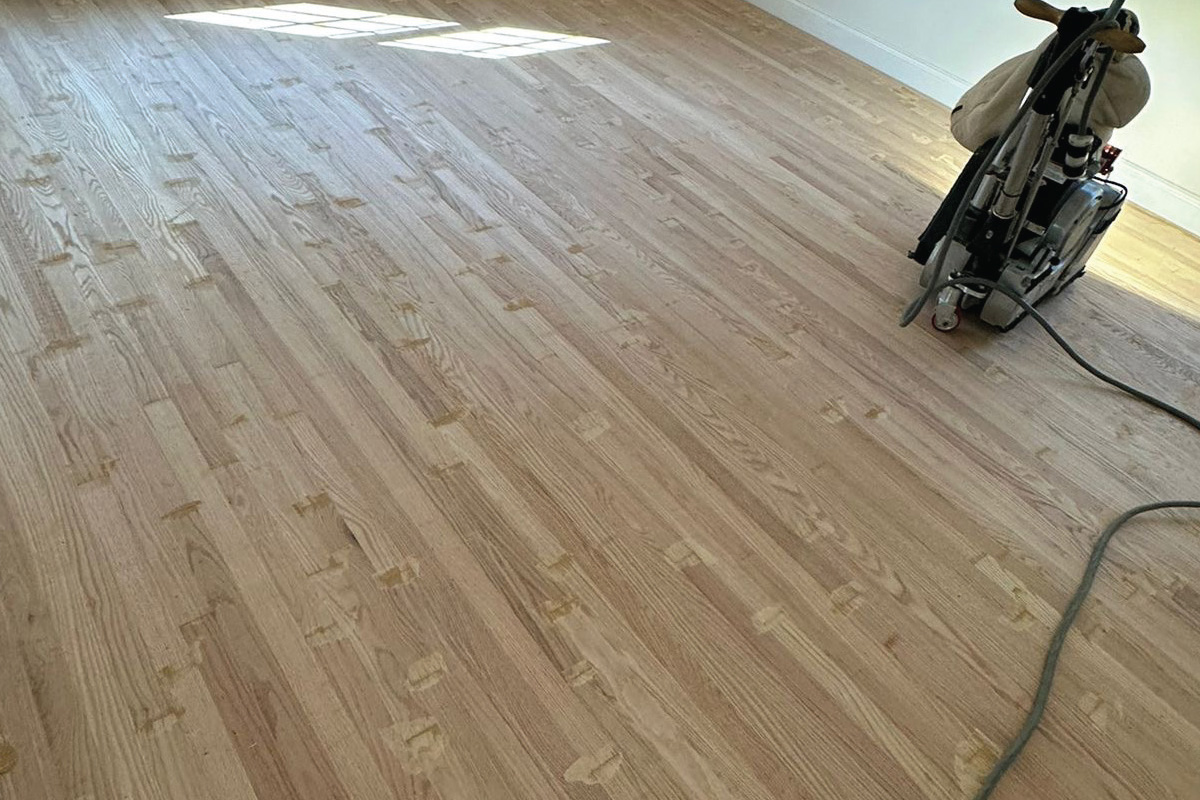
The most common line is a doorway piece, like a butt board we fit so the sanding stops on a clean straight edge. After that come the repairs people expect: stains and water damage. The next one surprises people. When a wall comes down in a renovation, it leaves a strip with no flooring under it. We weave new boards into that gap so the floor runs straight through.
Some small fixes cost much less when they come with a bigger job. A reducer strip at a sliding door can be $75 when we are already there for other work. Booked on its own, it costs more, because the trip, the setup and the finishing are the same as for any repair.
Repair Now, or Repair and Refinish?
You can replace a few boards without refinishing the floor. It works. It just does not blend very well.
New wood is a different color from wood that has been in your home for twenty years. Its finish is new and the rest of the floor's is not. Even a perfect fit stands out as a patch.
That is why 221 of our 319 repair jobs also included a full sand and refinish. Sanding the whole area takes everything down to bare wood. Then the old boards and the new ones get the same stain and the same coats at the same time. That is when the repair disappears.
| How the job was done | Jobs | Typical whole job |
|---|---|---|
| Repair only, no refinish | 95 | $450 |
| Repair, then the room or floor sanded and refinished (no new floor) | 201 | $3,485 |
The refinish usually covers the whole room or several rooms, about 470 square feet on a typical job, so most of that price is the refinish, not the repair. These prices are for the floor work only. Painting and stair work done on the same visit are left out.
If you were already thinking about refinishing, do the repair first, in the same visit. If you only need one spot fixed and can live with seeing it, a repair alone is fine. Sanding and refinishing costs about $4.50 a square foot on our quotes. See our refinishing cost guide for the full breakdown.
Want a price for your own floor?
Free in-home estimates across Monmouth, Mercer, Ocean and Middlesex counties. See our hardwood floor sanding and refinishing services.
When It Stops Being a Repair
A repair is a few boards. It makes sense when the problem is with those boards and nothing else.
It stops being a repair when:
- The installation itself has failed, and boards are loose or moving across the room.
- The water damage is heavy and has spread beyond one area.
- The subfloor underneath is soft, rotted or not sound.
At that point, the right fix is to take the old floor out and put a new one in. Our installation cost guide covers what that costs. When we come out, we check the boards, the fastening and the subfloor before we tell you which one you need.
Can You Match an Old Hardwood Floor?
Usually, yes. Most floors in New Jersey homes are 2 1/4 inch red oak or white oak. Those are still made, so we can buy the same species and width. Red oak was on 295 of our repair lines and white oak on 154.
When a floor is truly no longer made, there is only one way to match it. We take boards from somewhere less visible in the same house, like a closet, and use them for the repair. Then the closet gets new boards. That situation is rare. It came up on only a handful of our quotes.
The new boards also have to be close in moisture to the old ones. The National Wood Flooring Association standard is within 4% moisture content for strip floors under 3 inches wide, and within 2% for wider planks. If they are not, the new boards shrink or swell differently and the gaps show up later.